
Disclosure & Integrity Statement: The Vigor Project operates with complete editorial independence. To support our research, we use affiliate links. If you purchase through our links, we may earn a commission at no extra cost to you. This review evaluates formulation design and ingredient research, not clinical outcomes of the finished product. Our analysis is grounded in scientific literature, not marketing claims. – Alexander Vance, Ph.D. in Chemistry
HIIT is Not What You Think: A Chemist's Guide to Blood Sugar Control and Fat Loss
Let’s be honest. When you hear “exercise is key for blood sugar control,” what comes to mind? Probably the daunting image of long, monotonous jogs or endless hours at the gym. If you’re busy or managing health challenges, that advice can feel discouraging.
What if the most powerful tool wasn’t about logging more time, but about the quality of that time? What if you could trigger profound metabolic changes with sessions shorter than your coffee break?
As a Ph.D. Chemist, I’m less interested in fitness fads and more in the fundamental physiology of the human body. Today, we’re cutting through the noise to examine High-Intensity Interval Training (HIIT) through a scientific lens. Forget the elite athletes: we’ll explore how relative intensity makes this an accessible tool for anyone
1. Demystifying HIIT: It's About Physiology, Not Fitness Culture
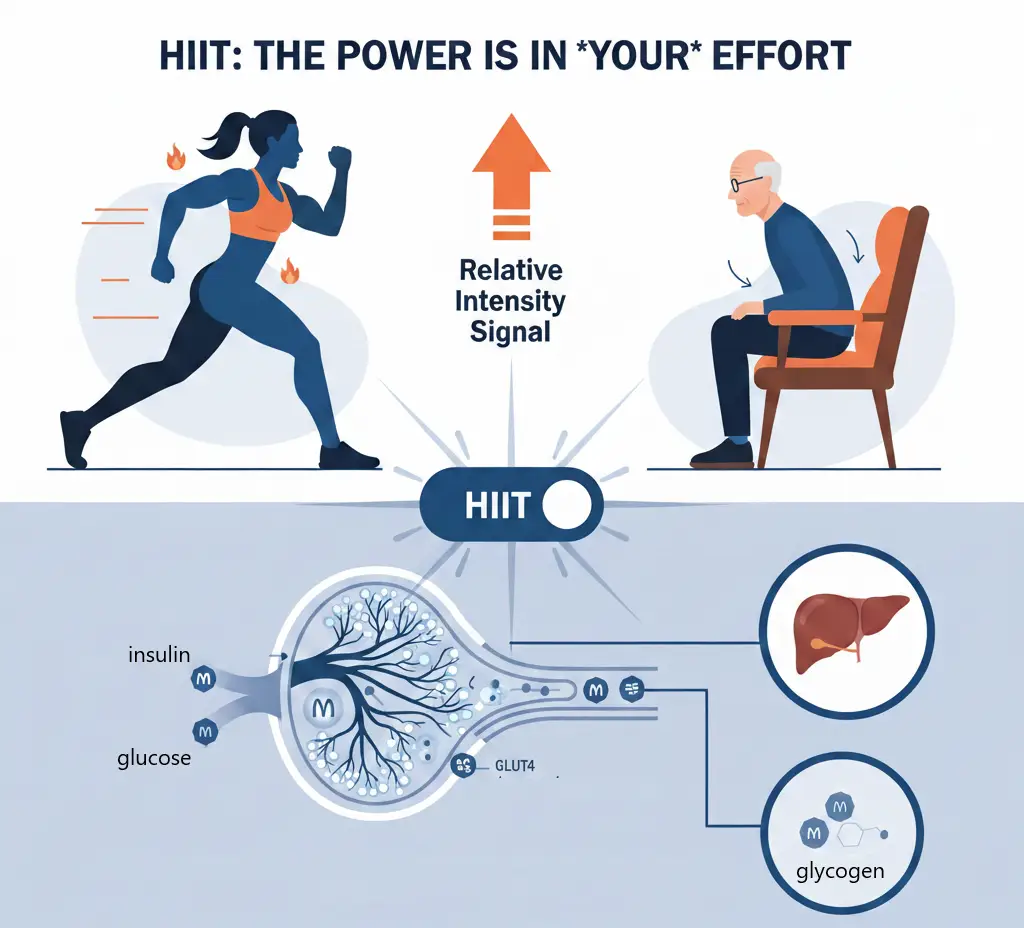
The textbook definition of HIIT is alternating short bursts of near-maximal effort with periods of recovery. But here is the key insight: “Near-maximal effort” is relative to YOUR current capacity.
For an athlete, high intensity is a sprint. For someone starting now, it could be a brisk walk or standing up from a sturdy chair repeatedly at a challenging pace.
The goal is to reach about 70-90% of your maximum heart rate. This intensity triggers a specific cascade of cellular responses that gentle exercise simply cannot elicit. It’s about signaling, not sport.
2. The Chemistry of Results: How HIIT Targets Blood Sugar and Fat
I see the body as an intricate system of pathways. HIIT is a powerful signal that recalibrates your metabolism through four main mechanisms:
Mechanism 1: Supercharging Insulin Sensitivity. During high effort, muscles create an urgent demand for glucose. Your cells become exponentially more sensitive to insulin: the “key” that unlocks your energy. Research shows HIIT can improve this sensitivity by 25-40%, with effects lasting for hours. This is why micronutrients like magnesium are so critical. They act as the spark for these insulin receptors (see my [Magnesium Analysis] for the chemistry behind this).
Mechanism 2: Building Better Cellular “Power Plants”. HIIT stimulates Mitochondrial Biogenesis. More mitochondria mean a greater capacity to burn glucose and fat efficiently. You aren’t just using energy; you are upgrading your body’s machinery.
Mechanism 3: Emptying the Liver’s Sugar Reserves. HIIT is highly effective at depleting hepatic glycogen (stored sugar in the liver). An “emptier” liver is far more receptive to insulin signals and better at managing blood sugar levels. Supporting the kidneys and liver in this drainage process is essential for long-term balance (I discussed this further in my comparision article [metabolic support from supplements])
Mechanism 4: Metabolic Flexibility and Fat Loss. By optimizing how your body handles glucose, HIIT forces your system to become “metabolically flexible”—better at switching between burning sugar and burning stored fat. This creates an “afterburn” effect (EPOC), where your metabolism remains elevated, burning more calories long after the workout is over.
⚠️ Important: The Metabolic Efficiency Factor
While the mechanisms above are biochemically sound, their real-world impact depends on your metabolic baseline. If your system is currently in a 'Metabolic Stall', HIIT might not be enough on its own to effectively access stored fat. To unlock the full benefits of this protocol, addressing these underlying biochemical hurdles is often a necessary complementary step.
Check if your metabolism is "stalled" →3. The Human-Friendly HIIT Protocol
The Golden Rule: Work hard for you, recover, and repeat. 2-3 times per week is sufficient.
| For You If… | “High Intensity” Work (30-60 sec) | Recovery (60-90 sec) | Total Session |
| Just Starting | Brisk walking in place | Slow walking | 10-20 min |
| At Home | Sit-to-stands from a chair | Seated, deep breaths | 10-20 min |
| Mobility Needs | Vigorous seated marching | Resting arms | 10-15 min |
| Advanced | Running Sprints or Stair climbing | Standing rest | 6-20 min |
The Chemist's Note: Metabolic Flexibility
HIIT is designed to rapidly deplete muscle glycogen stores. This depletion triggers a vital metabolic cascade: it increases muscle glucose uptake and promotes adaptive phenomena such as GLUT-4 translocation and mitochondrial biogenesis, which significantly enhance insulin sensitivity. When carbohydrates are consumed post-exercise, lasting up to 24 to 48 hours after a HIIT session, a substantial portion of that glucose is redirected to replenish muscle glycogen rather than spiking systemic blood sugar. In the short to medium term, this improves glycemic control and fosters metabolic flexibility, making fat loss a physiological byproduct of a more efficient system
4. Safety and Sustainability
Consult your doctor before starting, especially if you have cardiovascular conditions. Remember: Sharp pain is a stop signal; muscle burning and breathlessness are the “discomfort” of growth. Consistency trumps heroic, infrequent efforts.
5. Conclusion: HIIT as a Foundational Metabolic Tooonclusion: A Foundational Tool
HIIT works powerfully from the “outside-in,” improving how your muscles and liver respond to glucose. At The Vigor Project, we believe in a complete, science-backed picture of health.
To complement the “outside-in” benefits of exercise, I have already conducted deep-dive analyses into how specific nutritional compounds provide “inside-out” support.
For those looking to optimize their metabolic drainage and kidney-blood sugar connection, I recommend reading my [comparative analysis of blood sugar support formulas], where GlucoBerry emerged as the top scientific choice. Additionally, if you want to understand how essential minerals support the insulin pathways we discussed today, you can explore my [review of Magnesium Breakthrough].
Your Action Step: This week, block out 15 minutes. Try just 3 cycles of a “work/recovery” pattern from the table above. Listen to your body. You’ve just sent one of the most potent metabolic signals possible.

About the Author
Alexander Vance is the founder of The Vigor Project. He holds a Ph.D. in Chemistry with postgraduate specialization in exercise science. Through a rigorous molecular lens, he deconstructs the science behind metabolic health, dedicated to separating peer-reviewed evidence from industry hype.
Enjoyed this deep dive? To make it easier for you to apply these principles, I’ve prepared a downloadable 15-Minute Metabolic Reset Protocol (PDF).
Beyond what we discussed here, the PDF includes a practical application guide – two ways to HIIT (and the role of active recovery) and specific metabolic tables you can keep on your phone for quick reference during your workout.
Join the Vigor Insider below to receive the protocol and my weekly research-backed insights directly in your inbox.
References
Jelleyman, C., et al. (2015). The effects of high-intensity interval training on glucose regulation and insulin resistance… Sports Medicine. Meta-analysis showing significant HbA1c and insulin sensitivity (HOMA-IR) improvements from HIIT.
- Cassidy, S., Thoma, C., Houghton, D. et al. High-intensity interval training: a review of its impact on glucose control and cardiometabolic health. Diabetologia 60, 7–23 (2017). https://doi.org/10.1007/s00125-016-4106-1
Hood, M. S., et al. (2011). Exercise and the Regulation of Mitochondrial Biogenesis… Journal of Applied Physiology. Review outlining HIIT’s potent effect on mitochondrial biogenesis pathways.
van Loon, L. J. C., et al. (2001). Maximal fat oxidation during exercise in trained men. International Journal of Sports Medicine. Seminal work on substrate use, relevant to glycogen depletion.
- Islam, H., & Gillen, J. B. (2023). Skeletal muscle mechanisms contributing to improved glycemic control following intense interval exercise and training. Sports medicine and health science, 5(1), 20–28. https://doi.org/10.1016/j.smhs.2023.01.002