
Disclosure & Integrity Statement: The Vigor Project operates with complete editorial independence. To support our research, we use affiliate links. If you purchase through our links, we may earn a commission at no extra cost to you. This review evaluates formulation design and ingredient research, not clinical outcomes of the finished product. Our analysis is grounded in scientific literature, not marketing claims. – Alexander Vance, Ph.D. in Chemistry
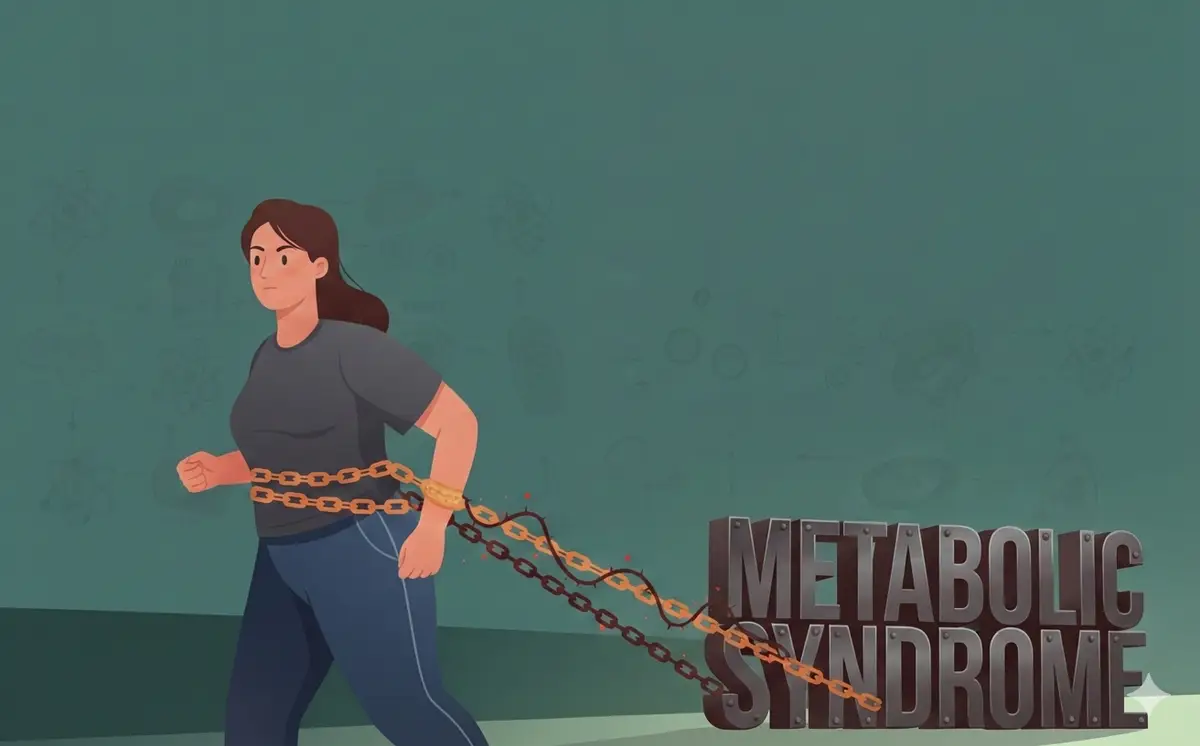
Why Your Body Resists Fat Loss: The Chemistry of the "Metabolic Stall"
The Frustrating Reality 104 cm. 108 mg/dL. 20%+ Body Fat.
A few years ago, those weren’t just numbers on a lab report; they were my reality. As a Ph.D. chemist, I understood the laws of thermodynamics. In theory, “calories in vs. calories out” should have been a simple linear equation. But my body wasn’t following the script.
If you’ve ever felt like you’re doing everything right (the diet, the exercise) and the scale simply won’t budge, you aren’t failing. Your internal chemistry is just “noisy.”
In clinical terms, Metabolic Syndrome is defined by a specific cluster of biochemical dysfunctions. You don’t need to hit every red flag; when at least three of these factors converge: abdominal obesity, elevated fasting glucose, high blood pressure, or abnormal lipid profiles, you have crossed a threshold. These markers don’t just add up; they multiply, creating a state of chronic, low-grade inflammation that re-programs how your cells handle energy.
The 3-out-of-5 Rule (Clinical Markers)
- Abdominal Obesity (Waist): ≥ 40" (men) | ≥ 35" (women)
- High Triglycerides: ≥ 150 mg/dL
- Low HDL Cholesterol: < 40 mg/dL (M) | < 50 mg/dL (W)
- High Blood Pressure: ≥ 130/80 mmHg
- High Fasting Sugar: ≥ 100 mg/dL
If you meet at least three of these, your internal chemistry is likely in "storage mode."
The Body as a Solvent, Not a Calculator
In chemistry, the environment (the solvent) dictates whether a reaction happens or stalls. In a state of Metabolic Syndrome, your body acts like a “congested solvent.”
Visceral fat, the stubborn weight around your midsection, isn’t just stored energy. It’s an active endocrine organ. It pumps out inflammatory cytokines (like IL-6 and TNF-α) that create a biological “wall.” This inflammation leads to two major chemical blockades:
Insulin Resistance: Your primary fat-burning enzyme (Hormone-Sensitive Lipase) is effectively “locked” because insulin levels remain chronically high to compensate for your blood sugar.
Leptin Resistance: Your brain becomes “deaf” to the signals of satiety. You aren’t hungry because you lack willpower; you’re hungry because your brain can’t “see” the energy you already have stored.
The Non-Linear Breakthrough
The most frustrating part of metabolic recovery is that the first phase feels like nothing is happening. You might lose a bit of visceral fat, but the scale barely moves.
However, behind the scenes, you are clearing the metabolic sludge. You are lowering the “activation energy” required for fat oxidation. Once your inflammatory markers drop and your insulin sensitivity improves, you cross a chemical threshold. Suddenly, the environment becomes “favorable,” and the fat loss that felt impossible starts to accelerate.
🔬 Scientist’s Note: Decoding the "Blood Sugar Drain"
In my research, I often encounter simplified marketing terms like the 'Blood Sugar Drain'. As a chemist, I prefer to look at the molecular reality: we are talking about the renal threshold for glucose."
Your kidneys act as a biological safety valve. When the system is efficient, they 'drain' excess sugar through the urine. However, when the glucose transporters (SGLT2) are overwhelmed by chronic inflammation, this 'valve' becomes sluggish, trapping sugar in your bloodstream regardless of how much you exercise.
I have conducted a technical analysis on the specific botanical compounds that support this renal clearance mechanism. You can read my full breakdown of the formula I currently recommend to address this chemical 'clog' here:
What to Do Next?
If you are currently in the “resistance phase,” do not stop. You aren’t just losing weight; you are re-engineering your internal chemistry.
To trigger the cellular “switch” needed to break this resistance, I recommend starting with a science-based HIIT protocol. You can read my full breakdown here: HIIT is Not What You Think: A Chemist’s Guide to Blood Sugar Control and Fat Loss
In some cases, specific micronutrients like Magnesium can help stabilize the nervous system during this transition. I’ve analyzed the leading research on that here: Magnesium Breakthrough Review: Does the “7-in-1” Formula Actually Work?

About the Author
Alexander Vance is the founder of The Vigor Project. He holds a Ph.D. in Chemistry with postgraduate specialization in exercise science. Through a rigorous molecular lens, he deconstructs the science behind metabolic health, dedicated to separating peer-reviewed evidence from industry hype.
References
- Maillard, F., Pereira, B. & Boisseau, N. Effect of High-Intensity Interval Training on Total, Abdominal and Visceral Fat Mass: A Meta-Analysis. Sports Med 48, 269–288 (2018). https://doi.org/10.1007/s40279-017-0807-y
- Zeggini E. (2007). A new era for Type 2 diabetes genetics. Diabetic medicine : a journal of the British Diabetic Association, 24(11), 1181–1186. https://doi.org/10.1111/j.1464-5491.2007.02274.x
- In brief. Nat Rev Nephrol 6, 630 (2010). https://doi.org/10.1038/nrneph.2010.138